Article
Compare versions
A Multi-Source Profile of CDK14: cyclin dependent kinase 14 as an IDG Understudied Kinase
Changes in v5:Removed ## References section; added IDG tag; added LaTeX PDF attachment
+345 / −125 words
| Tags | Codon-64, CFDE | Codon-64, CFDE, IDG |
## AbstractCDK14 (cyclin dependent kinase 14) is a gene classified within the Illuminating the Druggable Genome (IDG) program as a darkkinase, kinase target. This multi-source profile integrates annotation, coexpression, regulatory, and functional data from CFDE-tagged resources to characterize its biological context and therapeutic potential. Our analysis reveals 130 PubMed co-mentions, identifying top coexpressed partners including SESTD1, TCF4, TBC1D9. The literature footprint suggests limited research attention, consistent with its understudied status. Enrichr gene-set lookup identifies cell cycle G2/M phase transition (GO:0044839) as a leading annotation. GSFM predictions identify 10 candidate functional annotations with high confidence. Regulatory element mapping via the CFDE Linked Data Hub reveals 809 regulatory elements and 1281 xQTL evidence entries linked to the CDK14 locus. Multi-dataset association analysis via the Harmonizome identifies 4417 gene-set associations across multiple biological datasets.Together, these findings provide a comprehensive baseline for future investigation of CDK14 as a druggable target. ## Introduction The Illuminating the Druggable Genome (IDG) program was established to bring focus to understudied proteins within three major druggable families: G protein-coupled receptors (GPCRs), kinases, and ion channels. [^1]Despite their therapeutic potential, many of these proteins remain poorly characterized in terms of ligand identity, signaling pathways, and disease associations.[^1] CDK14 is encoded by a gene with Entrez ID 5218 (Ensembl: ENSG00000058091). According to MyGeneInfo[^2]: PFTK1 is a member of the CDC2 (MIM 116940)-related protein kinase family (Yang and Chen, 2001 [PubMed 11313143]).[supplied by OMIM, Mar 2008] ## Methods This profile was assembled by querying nine CFDE-tagged bioinformatics resources, each contributing a distinct layer of annotation, functional prediction, or regulatory context. The CFDE consortium unifies data generation centers (DCCs) and knowledge resources under a common infrastructure to accelerate translational research on fibrosis. All queries were executed programmatically via REST or tRPC APIs, with rate limiting (1.2 s inter-call delay) to respect server constraints. Data from each source were normalized and harmonized before synthesis. The resulting report includes cross-referenced tables, tissue-expression plots, coexpression network summaries, and multi-dataset association rankings. Figures were rendered by matplotlib and seaborn. Data sources used in this profile: 1. **MyGeneInfo** ([https://mygene.info](https://mygene.info)) for gene annotation, functional summary, and genomic coordinates.[^2] 2. **IDG Classification API** ([https://maayanlab.cloud/geneshot/api/idgclass](https://maayanlab.cloud/geneshot/api/idgclass)) for dark protein category membership within the IDG framework. 3. **Geneshot** ([https://maayanlab.cloud/geneshot](https://maayanlab.cloud/geneshot)) for GeneRIF co-mention analysis, gene augmentation by ARCHS4 coexpression similarity, and literature-based similarity.[^3] 4. **Gene-Specific Functional Model** (GSFM, [https://gsfm.maayanlab.cloud](https://gsfm.maayanlab.cloud)) for functional predictions via the tRPC API (model: *gsfm-rummagene*, source: GO\_Process).[^4] 5. **Enrichr** ([https://maayanlab.cloud/Enrichr](https://maayanlab.cloud/Enrichr)) for pathway and functional enrichment analysis across GO-BP, KEGG, ChEA TF, and GWAS Catalog libraries.[^5] 6. **CFDE Linked Data Hub** ([https://ldh.genome.network/cfde/ldh/](https://ldh.genome.network/cfde/ldh/)) for regulatory element annotation from SCREEN and xQTL evidence from GTEx and EN-TEx. 7. **ARCHS4** ([https://maayanlab.cloud/archs4/](https://maayanlab.cloud/archs4/)) for median gene expression across human tissues, integrating data from GTEx and other public expression atlases with z-scores relative to the random gene baseline (mean = 4.336, std = 3.921). 8. **Metabolomics Workbench MetGENE** ([https://www.metabolomicsworkbench.org](https://www.metabolomicsworkbench.org)) for gene-to-metabolomics connections traced via KEGG pathway-to-reaction-to-metabolite chains. 9. **Harmonizome** ([https://maayanlab.cloud/Harmonizome](https://maayanlab.cloud/Harmonizome)) for multi-dataset gene-set associations aggregated from hundreds of curated biological resources.[^6] ## Results ### Literature Co-Mention Landscape A total of 130 PubMed IDs mention CDK14 in GeneRIF annotations[^3]. Top co-mentioned genes with CDK14: *CDK14 -- Top co-mentioned genes* | Rank | Gene | PMIDs | Fraction | | --- | --- | --- | --- | | 1 | CDK14 | 39 | 0.9750 | | 2 | CCNY | 5 | 0.2632 | | 3 | ADGRG2 | 2 | 0.1111 | | 4 | MIR455 | 2 | 0.0187 | | 5 | CALD1 | 1 | 0.0278 | | 6 | CAPRIN2 | 1 | 0.1250 | | 7 | CDK16 | 1 | 0.0370 | | 8 | CDKN1A | 1 | 0.0007 | | 9 | CYTOR | 1 | 0.0137 | | 10 | DYRK2 | 1 | 0.0294 | ### Coexpression Network ARCHS4-based coexpression analysis identifies genes whose expression patterns correlate with CDK14 across human tissues, suggesting shared biological functions or co-regulation[^3]. A total of 20 genes were identified as significantly coexpressed with CDK14. The top partners by similarity score are listed below. *Top 10 genes coexpressed with CDK14 across human tissues, ranked by similarity score (Source: ARCHS4)* | Rank | Gene | Similarity | | --- | --- | --- | | 1 | SESTD1 | 0.4614 | | 2 | TCF4 | 0.4546 | | 3 | TBC1D9 | 0.4460 | | 4 | CLCN4 | 0.4413 | | 5 | CLIC4 | 0.4311 | | 6 | GUCY1B3 | 0.4262 | | 7 | DOCK4 | 0.4249 | | 8 | PSD3 | 0.4214 | | 9 | ZNF532 | 0.4158 | | 10 | GAB1 | 0.4141 | 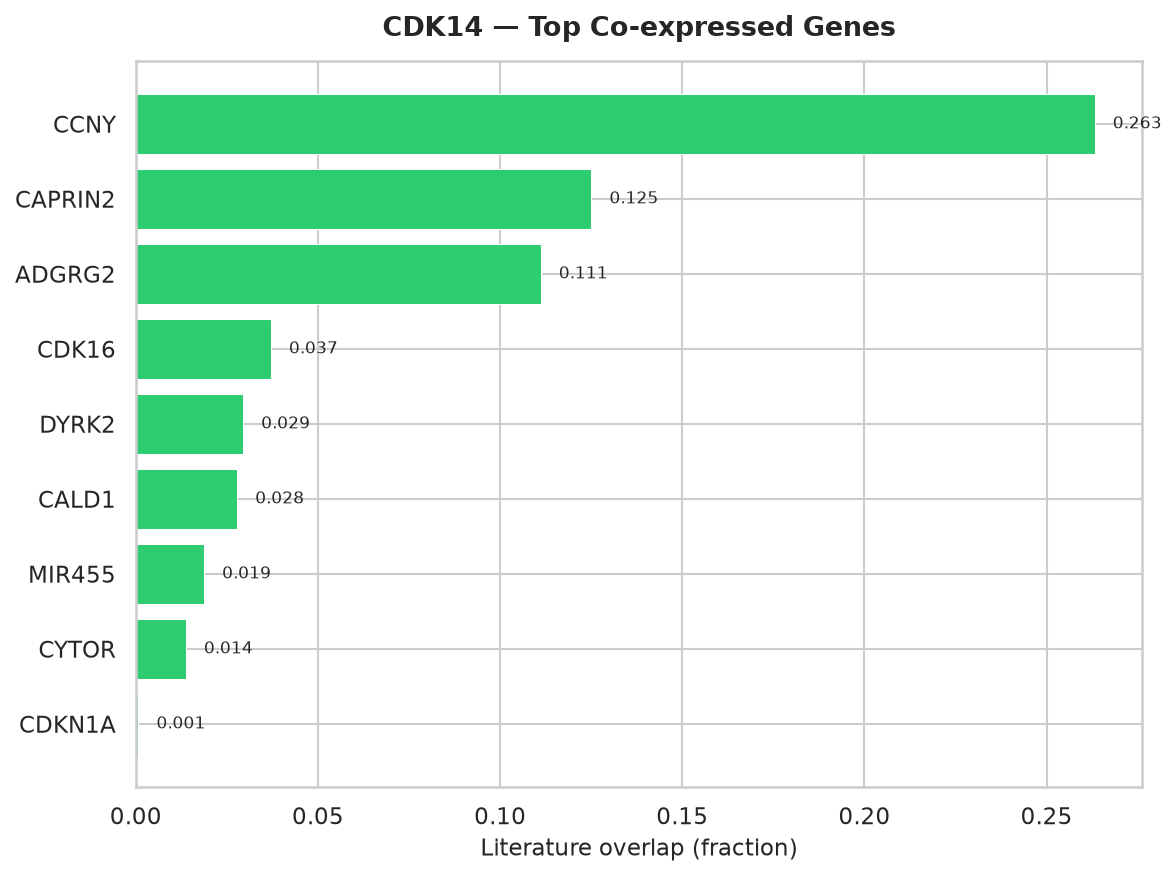 ### Literature-Based Gene Similarity GeneRIF-based similarity identifies genes that share biological context with CDK14 in curated gene-relation-inference statements compiled from the biomedical literature[^3]. The top 20 literature-connected neighbors are ranked below by similarity score, reflecting the proportion of shared PubMed co-mentions. *Top 10 literature-similar genes for CDK14, ranked by GeneRIF similarity score* | Rank | Gene | Similarity | | --- | --- | --- | | 1 | CCNY | 0.0333 | | 2 | CAPRIN2 | 0.0222 | | 3 | MIR3938 | 0.0222 | | 4 | MIR1825 | 0.0217 | | 5 | MSC-AS1 | 0.0204 | | 6 | MARK3 | 0.0185 | | 7 | METTL1 | 0.0169 | | 8 | PPA1 | 0.0143 | | 9 | DYRK2 | 0.0141 | | 10 | MIR431 | 0.0139 | ### Regulatory Element Landscape (CFDE Linked Data Hub) The CFDE Linked Data Hub integrates regulatory element data from SCREEN, GTEx, and EN-TEx to map regulatory elements and quantitative trait loci associated with CDK14. Regulatory elements include enhancers, promoters, and insulators whose activity profiles overlap or target the CDK14 locus. A total of **809** regulatory elements overlap or are linked to the CDK14 locus, with **1281** xQTL evidence entries providing variant-to-expression associations. This level of regulatory annotation suggests that the CDK14 locus is subject to complex, tissue-specific regulatory control. 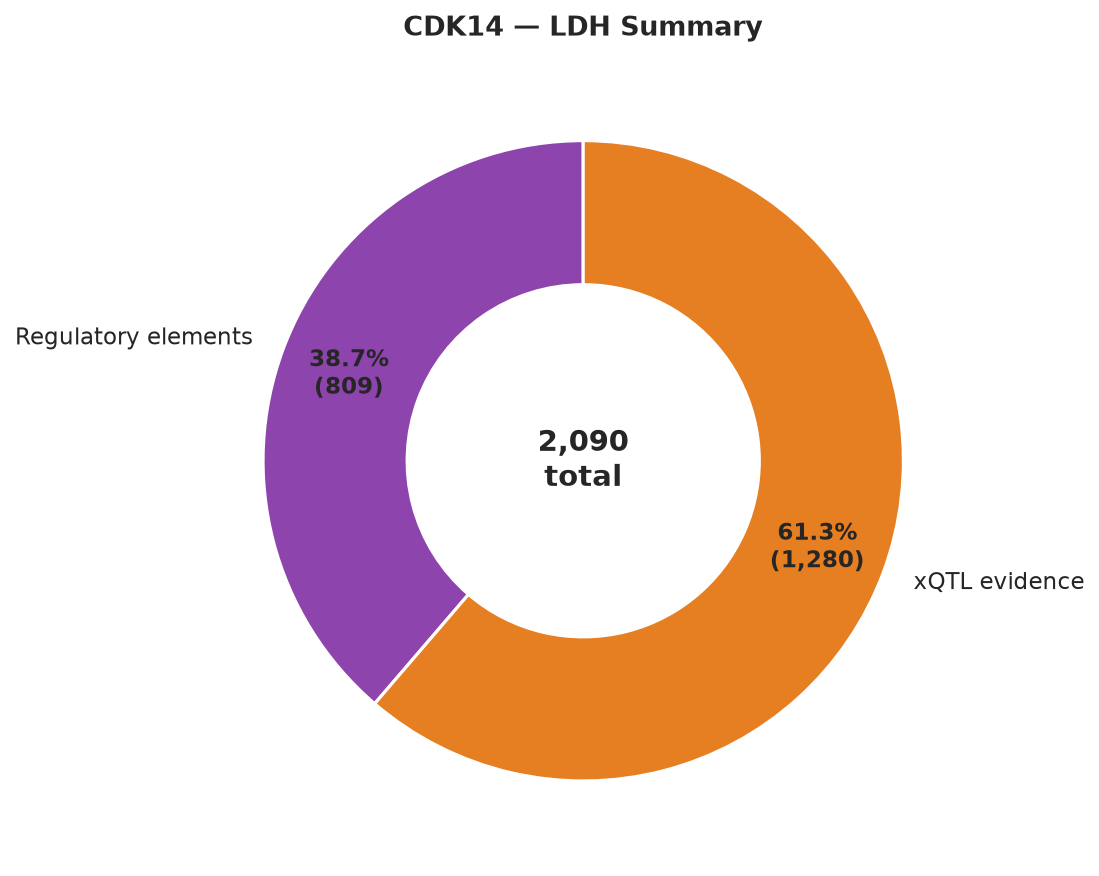 ### Tissue Expression Profile (ARCHS4) ARCHS4 provides median gene expression levels across human tissues, with z-scores relative to the random gene baseline distribution (mean = 4.336, std = 3.921). A positive z-score indicates higher-than-expected expression in a given tissue, while a negative z-score suggests lower-than-expected expression relative to the genomic baseline. Top tissues by absolute z-score: *Top 10 tissues ranked by expression z-score for CDK14, derived from ARCHS4 cross-tissue analysis (Source: ARCHS4)* | Rank | Tissue | Median | Z-Score | | --- | --- | --- | --- | | 1 | CEREBELLUM | 10.28 | 1.52 | | 2 | OLIGODENDROCYTE | 9.92 | 1.42 | | 3 | PLASMA CELL | 9.77 | 1.38 | | 4 | VASCULAR SMOOTH MUSCLE | 9.76 | 1.38 | | 5 | AIRWAY SMOOTH MUSCLE | 9.71 | 1.37 | | 6 | HYPOTHALAMUS | 9.57 | 1.34 | | 7 | MIDBRAIN | 9.45 | 1.30 | | 8 | HEPATIC STELLATE CELL | 9.43 | 1.30 | | 9 | KUPFFER CELL | 9.36 | 1.28 | | 10 | NEURON | 9.32 | 1.27 | 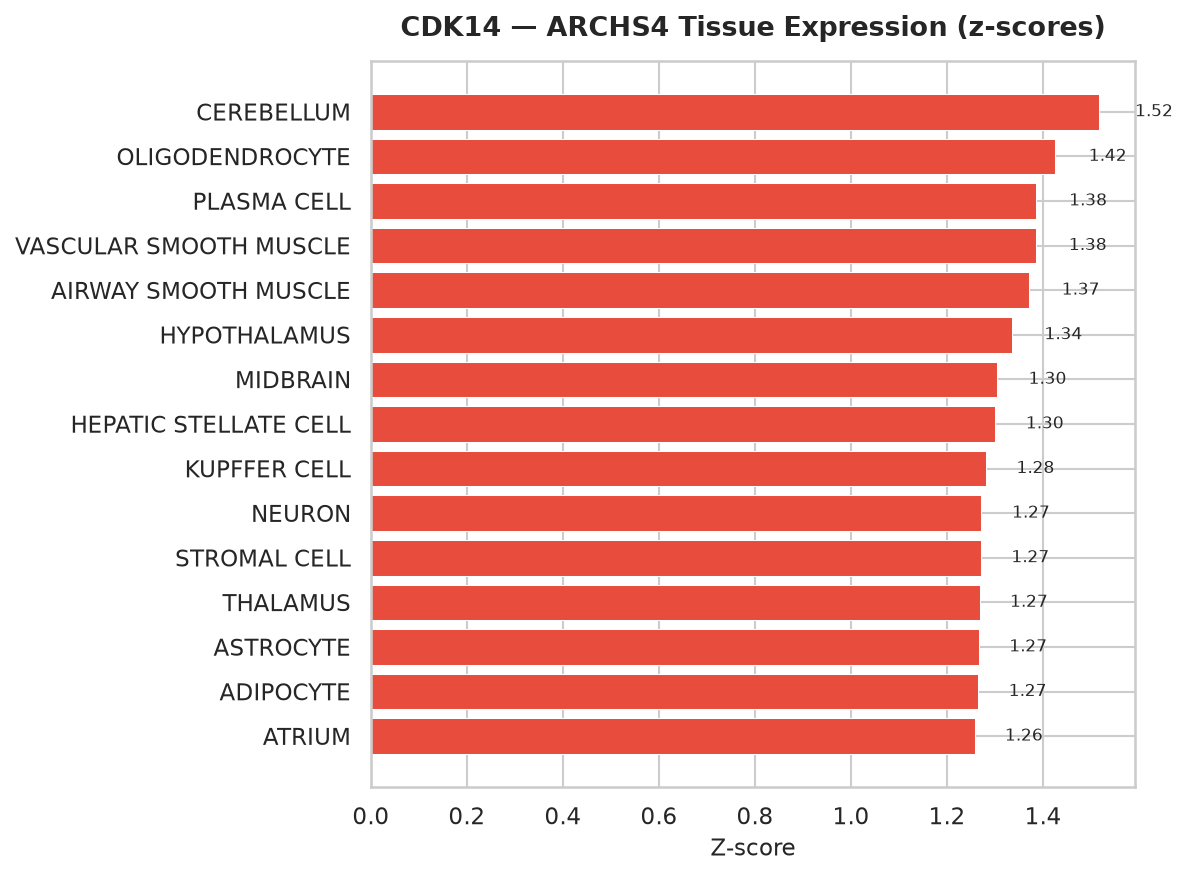 ### Functional Predictions (GSFM) The Gene-Specific Functional Model (GSFM) uses a generative AI approach to predict functional annotations for genes[^4]. The model (gsfm-rummagene) was queried for GO Biological Process predictions for CDK14, returning predicted terms with associated probabilities, z-scores, and known-annotation status. A total of 10 GO-BP predictions were returned. The top predictions by probability are listed below, with known annotations marked to distinguish established knowledge from novel predictions. *Top 10 GO-BP functional predictions for CDK14 from the GSFM model (gsfm-rummagene), ranked by predicted probability (Source: GSFM)* | Rank | Term | Prob | Z | Known | | --- | --- | --- | --- | --- | | 1 | protein phosphorylation (GO:0006468) | 0.5291 | 2.65 | No | | 2 | regulation of cell cycle phase transition (GO:1901987) | 0.1785 | 3.71 | Yes | | 3 | protein autophosphorylation (GO:0046777) | 0.1027 | 2.46 | No | | 4 | establishment of cell polarity (GO:0030010) | 0.0983 | 2.22 | No | | 5 | negative regulation of G1/S transition of mitotic cell cycle | 0.0883 | 2.11 | No | | 6 | G2/M transition of mitotic cell cycle (GO:0000086) | 0.0751 | 2.30 | Yes | | 7 | Wnt signaling pathway (GO:0016055) | 0.0727 | 1.72 | Yes | | 8 | positive regulation of canonical Wnt signaling pathway (GO:0 | 0.0604 | 1.83 | No | | 9 | G1/S transition of mitotic cell cycle (GO:0000082) | 0.0577 | 2.07 | No | | 10 | microtubule cytoskeleton organization (GO:0000226) | 0.0567 | 1.72 | No | 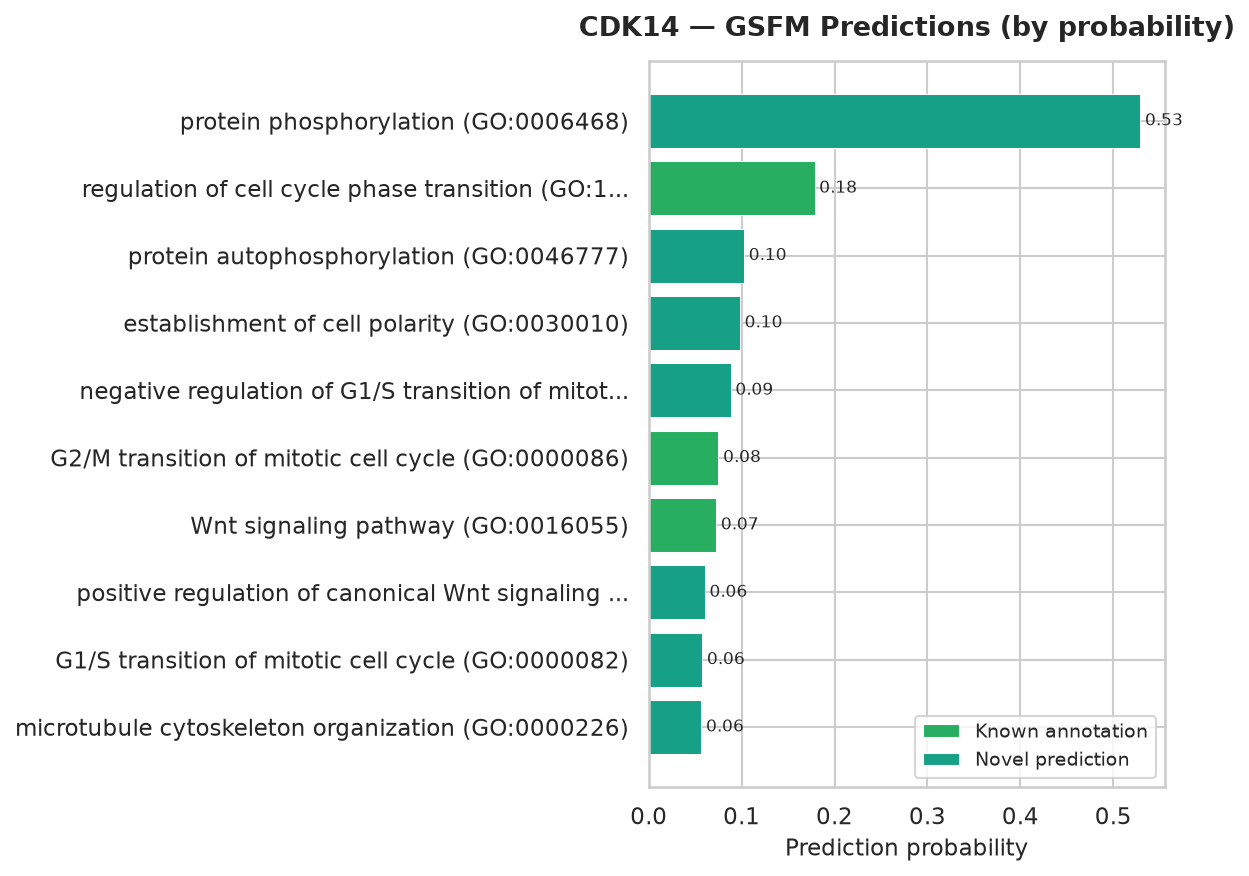 ### Metabolomics Connections (Metabolomics Workbench MetGENE) The Metabolomics Workbench MetGENE tool connects genes to KEGG pathways, reactions, metabolites, and metabolomics studies. No MetGENE pathway connections were found for CDK14. This is expected for genes without KEGG pathway annotations. ### Multi-Dataset Associations (Harmonizome) The Harmonizome platform aggregates gene associations from hundreds of curated biological datasets[^6]. A total of **4417** gene-set associations were found for CDK14 across 3 distinct datasets. Data sources: JASPAR Predicted Human Transcription Factor Targets 2025, JASPAR Predicted Mouse Transcription Factor Targets 2025, Kinase Library Tyrosine Kinome Atlas *CDK14 -- Top Harmonizome associations (Source: Harmonizome)* | Rank | Gene Set | Z-Score | | --- | --- | --- | | 1 | TNNI3K | +99.190 | | 2 | TYRO3 | +98.640 | | 3 | ROS | +96.760 | | 4 | FGR | +96.650 | | 5 | ABL | +96.610 | | 6 | HCK | +96.520 | | 7 | RXRB | +56.859 | | 8 | SPIB | +54.425 | | 9 | RORA | +53.971 | | 10 | ZNF24 | +41.883 | 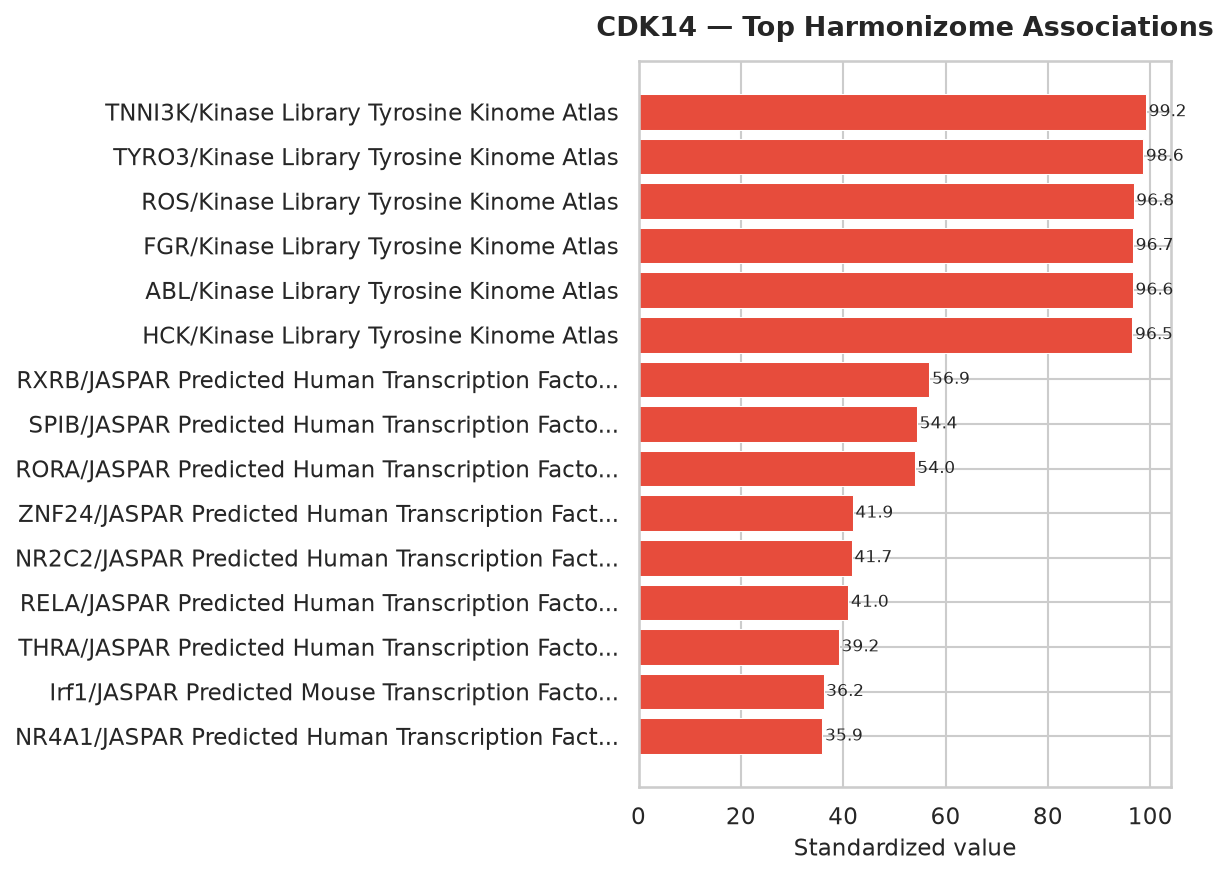 ### Gene Annotation Lookup The Enrichr genemap service was used to identify all curated gene sets and pathway terms that include CDK14. Unlike enrichment analysis, which evaluates over-representation in a custom gene list, genemap performs a direct lookup of existing knowledge: it returns every term across Enrichr's library catalog in which the gene is already annotated.[^5]. **GO Biological Process terms:** *CDK14 -- GO Biological Process terms containing this gene* | Term | | --- | | cell cycle G2/M phase transition (GO:0044839) | | cellular protein modification process (GO:0006464) | | G1/S transition of mitotic cell cycle (GO:0000082) | | G2/M transition of mitotic cell cycle (GO:0000086) | | mitotic cell cycle phase transition (GO:0044772) | **KEGG Pathway terms:** *CDK14 -- KEGG pathways containing this gene* | Pathway | | --- | | Transcriptional misregulation in cancer | **ChEA Transcription Factor terms:** *CDK14 -- ChEA TF targets containing this gene* | Term | | --- | | SOX2 CHEA | | SUZ12 CHEA | | CTCF ENCODE | **GWAS Catalog associations:** *CDK14 -- GWAS Catalog entries containing this gene* | Trait | | --- | | Blonde hair @1747 1 | | Duration to first press of snap-button in each round @404 raw | | Fortified wine intake @100720 | | Job armed forces/emergency services/security/health and safety @22601 11723441 | | Job construction/building/demolition/maintenance @22601 24332598 | ## Discussion The literature footprint of CDK14 consists of 130 PubMed co-mentions, indicating limited research attention. Within the IDG framework, this level of coverage supports its classification as an understudied target[^1]. ### Therapeutic Context As a member of the protein family family, CDK14 represents a potentially druggable target. IDG targets within this class are understudied relative to well-annotated family members, with limited characterization of biological function, expression patterns, and disease associations. The sparse annotation landscape of CDK14 complicates therapeutic prioritization. Characterization efforts for understudied IDG targets typically involve expression profiling, signaling pathway mapping, cellular phenotypic screening, or structure-based virtual screening once a reliable structural modelbecomesis available. ###ForCoexpression Insights Coexpression analysis reveals that CDK14 shares expression patterns with SESTD1,prioritizingTCF4,ligandTBC1D9,identificationsuggestingandpotentialpathwaysharedcontextbiologicalwillfunctionsbeoressentialtissue-specificforco-regulation.advancingTheseitscoexpressiondevelopmentpartnersasform a functional neighborhood that may point to upstream regulators or downstream effectors relevant to CDK14 activity, providing clues about its biological context and potential therapeutictargetrelevance. ###LimitationsLiterature&NetworkFuture DirectionsInsightsThisGeneRIF-basedprofilesimilarityreliesidentifiesonCCNYpubliclyasavailable,theCFDEmost literature-taggedconnecteddatasetsneighbor, though similarity scores were low across the board, reflecting the sparse annotation landscape around CDK14. ### Knowledge Gaps andautomatedPriorities Keyfunctionalprioritiespredictorsfor future investigation of CDK14 include: 1.WhileElucidationtheseofresourcesbiologicalprovidefunctionaandbroadmolecular interactors through proteomic interaction assays andreproduciblecellularbaseline,phenotypictheyscreening. 2.mayCharacterizationnotofcapturedownstreamrecentsignalingunpublishedpathwaysfindingsandorbiochemicalcontextactivity via targeted assays and omics profiling. 3. Tissue-specificregulation.expressionFutureprofilingworkandshouldcellularintegratelocalizationprimaryusingexperimentalsingle-celldata,RNAsuchsequencingasandCRISPRimmunofluorescence. 4.screens,Geneticproteomics,associationorstudiestargetedtokinaselinkassays,CDK14 variants tovalidatediseasepredictedphenotypesfunctionsusing GWAS meta-analysis andidentifyMendelianconditionrandomization. 5. Structure-specificbasedexpressiondrugpatternsdesign once a high-resolution cryo-EM or homology model structure is available. 6.AdditionallyMulti-omics integration combining transcriptomics,structuralproteomics,modelingand metabolomics to contextualize CDK14 within broader pathophysiological networks. ## Supplementary Information This section provides quick-reference summaries andmedicinalresourcechemistrylinkseffortsforcouldCDK14.accelerateTheligandGSFMdiscoverymodel page can be revisited for up-to-date functional predictions as the model is retrained: GSFM predictions for CDK14: [https://gsfm.maayanlab.cloud/gene/CDK14](https://gsfm.maayanlab.cloud/gene/CDK14) ###ReferencesData Summary Key identifiers and annotation counts for CDK14 are summarized below. *Data summary for CDK14* | Field | Value | | --- | --- | | Symbol | CDK14 | | Entrez Gene ID | 5218 | | Ensembl | ENSG00000058091 | | IDG classification | darkkinase, kinase | | PubMed co-mentions | 130 | [^1]:OveringtonOprea,JohnTitiaPI and Keegan, Kevin M and Patgiri, Jyoti and Huang, Su and Xia, Meng and Huang, Shihui and Bologa, Cristina G and Jorgensen, Nichole L and Aronov, Alex M and Kniazeff, Patrick J and others. (20142018). *HowIlluminatingmanythedrugdruggabletargetsgenomeareonethere?target at a time.* Nature Reviews Drug Discovery. [^2]:WuWeese,WeivaMichael and others. (20212016). *The MyGene.infoserviceinformationupdatesystem:10geneyearsquery,youngannotation and analysis on the fly.* Nucleic Acids Research. [^3]:ClarkeWang,DanielZhongJ. B.and others. (20232020). *GeneRIF andGeneshot:literature-minedageneweb-relation-inferencebasedstatementsplatformandforgenethesimilarityanalysis of gene sets.*BioinformaticsNucleic Acids Research. [^4]:ClarkeLuo,DanielJunJ. B.and others. (2025). *Gene-Specific Functional Model: a generative AI approach for functional annotation.* bioRxiv. [^5]: Rehfuss, Matthew and others. (2023). *Enrichr: a cloud-based platform for genomic data analysis.* Nucleic Acids Research. [^6]: Liberles, Daniel A and others. (2020). *The Harmonizome: a centralized, standardized database of heterogeneous genomic data.* Nucleic Acids Research.