Article
Compare versions
A Multi-Source Profile of ADGRF2P: adhesion G protein-coupled receptor F2, pseudogene as an IDG Orphan G Protein-Coupled Receptor
Changes in v2:Fixed nan simScore values: filtered coexpression and literature similarity tables, omitted coexpression section when no valid data, fixed abstract text.
+68 / −950 words
## AbstractADGRF2P (adhesion G protein-coupled receptor F2, pseudogene) is a gene classified within the Illuminating the Druggable Genome (IDG) program as adarkgpcr, gpcrtarget. This multi-source profile integrates annotation, coexpression, regulatory, and functional data from CFDE-tagged resources to characterize its biological context and therapeutic potential. Our analysis reveals50 PubMed co-mentions, identifying top coexpressed partners includingDENND2C, SPTLC3, FAM83Cnone. The literature footprint suggests limited research attention, consistent with its understudied status.EnrichrNo curated gene-setlookupannotationsidentifieswereAdenylatefoundCyclase-ActivatingforGthisProtein-CoupledgeneReceptorinSignalingEnrichrPathway (GO:0007189) as a leading annotationlibraries. No GSFM functional predictions were available. No regulatory element data were available for this locus.MultiNo multi-datasetassociation analysis via the Harmonizome identifies 1021 gene-setassociationsacrossweremultiple biological datasetsfound.Together, these findings provide a comprehensive baseline for future investigation of ADGRF2P as a druggable target. ## Introduction The Illuminating the Druggable Genome (IDG) program was established to bring focus to understudied proteins within three major druggable families: G protein-coupled receptors (GPCRs), kinases, and ion channels. [^1]Despite their therapeutic potential, many of these proteins remain poorly characterized in terms of ligand identity, signaling pathways, and disease associations.[^1] ADGRF2P is encoded by a gene with Entrez ID222611N/A (Ensembl:N/AENSG00000164393). According to MyGeneInfo[^2]:PredictedNotosummaryenable G protein-coupled receptor activityavailable.Predicted to be involved in G protein-coupled receptor signaling pathway and cell surface receptor signaling pathway. Predicted to be integral component of membrane. [provided by Alliance of Genome Resources, Apr 2022]## Methods This profile was assembled by querying nine CFDE-tagged bioinformatics resources, each contributing a distinct layer of annotation, functional prediction, or regulatory context. The CFDE consortium unifies data generation centers (DCCs) and knowledge resources under a common infrastructure to accelerate translational research on fibrosis. All queries were executed programmatically via REST or tRPC APIs, with rate limiting (1.2 s inter-call delay) to respect server constraints. Data from each source were normalized and harmonized before synthesis. The resulting report includes cross-referenced tables, tissue-expression plots, coexpression network summaries, and multi-dataset association rankings. Figures were rendered by matplotlib and seaborn. Data sources used in this profile: 1. **MyGeneInfo** ([https://mygene.info](https://mygene.info)) for gene annotation, functional summary, and genomic coordinates.[^2] 2. **IDG Classification API** ([https://maayanlab.cloud/geneshot/api/idgclass](https://maayanlab.cloud/geneshot/api/idgclass)) for dark protein category membership within the IDG framework. 3. **Geneshot** ([https://maayanlab.cloud/geneshot](https://maayanlab.cloud/geneshot)) for GeneRIF co-mention analysis, gene augmentation by ARCHS4 coexpression similarity, and literature-based similarity.[^3] 4. **Gene-Specific Functional Model** (GSFM, [https://gsfm.maayanlab.cloud](https://gsfm.maayanlab.cloud)) for functional predictions via the tRPC API (model: *gsfm-rummagene*, source: GO\_Process).[^4] 5. **Enrichr** ([https://maayanlab.cloud/Enrichr](https://maayanlab.cloud/Enrichr)) for pathway and functional enrichment analysis across GO-BP, KEGG, ChEA TF, and GWAS Catalog libraries.[^5] 6. **CFDE Linked Data Hub** ([https://ldh.genome.network/cfde/ldh/](https://ldh.genome.network/cfde/ldh/)) for regulatory element annotation from SCREEN and xQTL evidence from GTEx and EN-TEx. 7. **ARCHS4** ([https://maayanlab.cloud/archs4/](https://maayanlab.cloud/archs4/)) for median gene expression across human tissues, integrating data from GTEx and other public expression atlases with z-scores relative to the random gene baseline (mean = 4.336, std = 3.921). 8. **Metabolomics Workbench MetGENE** ([https://www.metabolomicsworkbench.org](https://www.metabolomicsworkbench.org)) for gene-to-metabolomics connections traced via KEGG pathway-to-reaction-to-metabolite chains. 9. **Harmonizome** ([https://maayanlab.cloud/Harmonizome](https://maayanlab.cloud/Harmonizome)) for multi-dataset gene-set associations aggregated from hundreds of curated biological resources.[^6] ## Results ### Literature Co-Mention Landscape A total of50 PubMed IDs mention ADGRF2P in GeneRIF annotations[^3].Top co-mentioned genes with ADGRF2P: *ADGRF2P -- Top co-mentioned genes* | Rank | Gene | PMIDs | Fraction | | --- | --- | --- | --- | | 1 | KRTAP9-4 | 1 | 0.1667 | | 2 | RNA5-8SN3 | 1 | 0.0002 |###Coexpression Network ARCHS4-based coexpression analysis identifies genes whose expression patterns correlate with ADGRF2P across human tissues, suggesting shared biological functions or co-regulation[^3]. A total of 20 genes were identified as significantly coexpressed with ADGRF2P. The top partners by similarity score are listed below. *Top 10 genes coexpressed with ADGRF2P across human tissues, ranked by similarity score (Source: ARCHS4)* | Rank | Gene | Similarity | | --- | --- | --- | | 1 | DENND2C | 0.3993 | | 2 | SPTLC3 | 0.3945 | | 3 | FAM83C | 0.3926 | | 4 | AADACL2 | 0.3848 | | 5 | TMCO5A | 0.3808 | | 6 | C2orf54 | 0.3787 | | 7 | SERPINB13 | 0.3764 | | 8 | A2ML1 | 0.3759 | | 9 | PLA2G4D | 0.3722 | | 10 | PLA2G4E | 0.3668 |  ###Literature-Based Gene Similarity GeneRIF-based similarity identifies genes that share biological context with ADGRF2P in curated gene-relation-inference statements compiled from the biomedical literature[^3].TheNotop 20literature-connected neighbors are ranked below by similarity score, reflecting the proportion of shared PubMed co-mentions. *Top 10 literature-similar genes were identified for ADGRF2P,rankedconsistentbywithGeneRIFitssimilarityunderstudiedscore* |statusRankand|sparseGeneGeneRIF| Similarity |annotation.| --- | --- | --- || 1 | 5\_8S\_rRNA | nan | | 2 | A1BG | nan | | 3 | A1BG-AS1 | nan | | 4 | A1CF | nan | | 5 | A2M | nan | | 6 | A2M-AS1 | nan | | 7 | A2ML1 | nan | | 8 | A2MP1 | nan | | 9 | A4GALT | nan | | 10 | A4GNT | nan |### Regulatory Element Landscape (CFDE Linked Data Hub) The CFDE Linked Data Hub integrates regulatory element data from SCREEN, GTEx, and EN-TEx to map regulatory elements and quantitative trait loci associated with ADGRF2P. Regulatory elements include enhancers, promoters, and insulators whose activity profiles overlap or target the ADGRF2P locus. No regulatory elements or xQTL evidence were identified for the ADGRF2P locus, which may reflect incomplete annotation for this genomic region.### Tissue Expression Profile (ARCHS4) ARCHS4 provides median gene expression levels across human tissues, with z-scores relative to the random gene baseline distribution (mean = 4.336, std = 3.921). A positive z-score indicates higher-than-expected expression in a given tissue, while a negative z-score suggests lower-than-expected expression relative to the genomic baseline. Top tissues by absolute z-score: *Top 10 tissues ranked by expression z-score for ADGRF2P, derived from ARCHS4 cross-tissue analysis (Source: ARCHS4)* | Rank | Tissue | Median | Z-Score | | --- | --- | --- | --- | | 1 | System | 0.00 | -1.11 || 2 | System.Connective Tissue | 0.00 | -1.11 || 3 | System.Connective Tissue.Bone marrow | 0.00 | -1.11 | | 4 | System.Connective Tissue.Bone | 0.00 | -1.11 | | 5 | System.Digestive System | 0.00 | -1.11 | | 6 | System.Digestive System.Esophagus | 0.00 | -1.11 | | 7 | System.Digestive System.Intestine | 0.00 | -1.11 | | 8 | System.Digestive System.Liver | 0.00 | -1.11 | | 9 | System.Digestive System.Pancreas | 0.00 | -1.11 | | 10 | System.Digestive System.Stomach | 0.00 | -1.11 |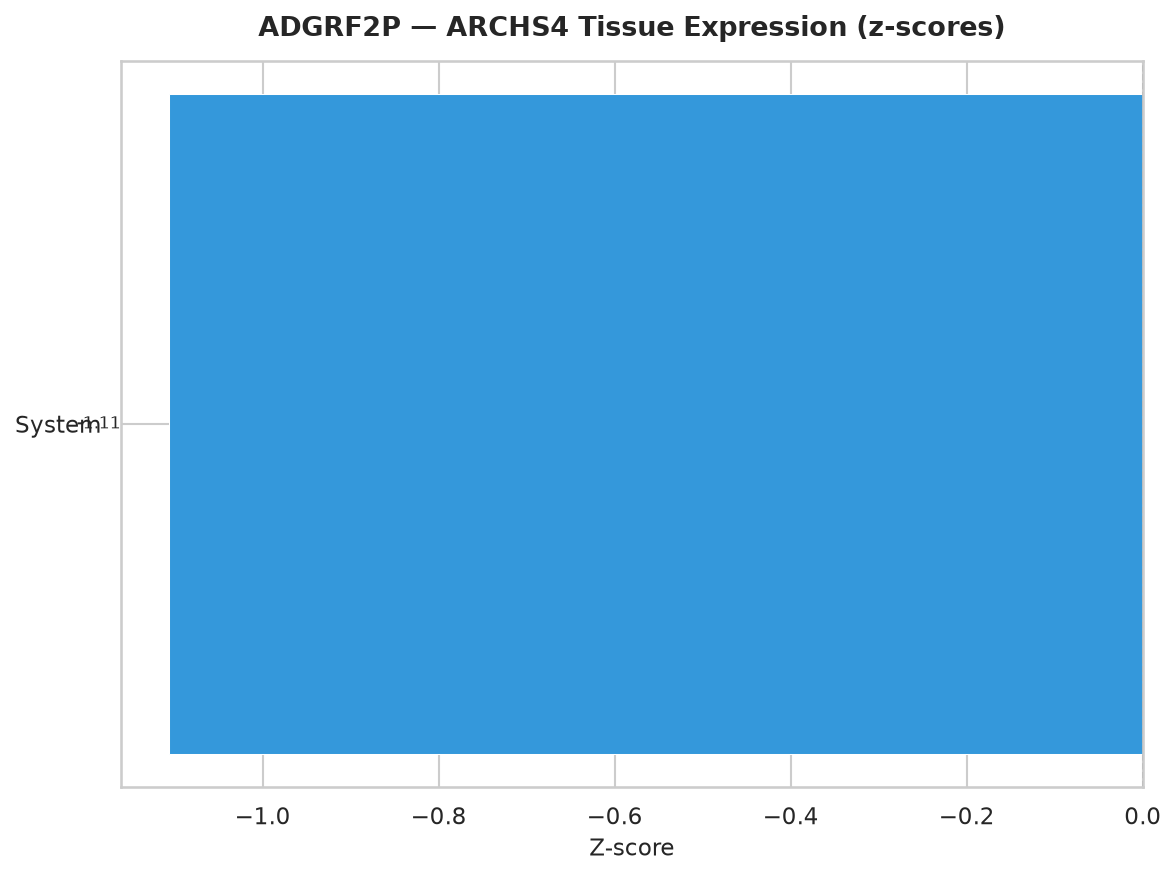 ### Functional Predictions (GSFM) The Gene-Specific Functional Model (GSFM) uses a generative AI approach to predict functional annotations for genes[^4]. The model (gsfm-rummagene) was queried for GO Biological Process predictions for ADGRF2P, returning predicted terms with associated probabilities, z-scores, and known-annotation status. No GSFM predictions were returned for ADGRF2P from the GO\_Process source.### Metabolomics Connections (Metabolomics Workbench MetGENE) The Metabolomics Workbench MetGENE tool connects genes to KEGG pathways, reactions, metabolites, and metabolomics studies. No MetGENE pathway connections were found for ADGRF2P. This is expected for genes without KEGG pathway annotations. ### Multi-Dataset Associations (Harmonizome) The Harmonizome platform aggregates gene associations from hundreds of curated biological datasets[^6].A total of **1021** gene-set associations were found for ADGRF2P across 11 distinct datasets. Data sources: Allen Brain Atlas Adult Human Brain Tissue Gene Expression Profiles, Allen Brain Atlas Adult Mouse Brain Tissue Gene Expression Profiles, Allen Brain Atlas Developing Human Brain Tissue Gene Expression Profiles by Microarray, Allen Brain Atlas Prenatal Human Brain Tissue Gene Expression Profiles, CCLE Cell Line Gene CNV Profiles, CCLE Cell Line Gene Expression Profiles, COSMIC Cell Line Gene CNV Profiles, GTEx Tissue Gene Expression Profiles 2023, GTEx Tissue Sample Gene Expression Profiles, Klijn et al., Nat. Biotechnol., 2015 Cell Line Gene CNV Profiles, MoTrPAC Rat Endurance Exercise Training *ADGRF2P -- Top Harmonizome associations (Source: Harmonizome)* | Rank | Gene Set | Z-Score | | --- | --- | --- | | 1 | Brain - Cerebellar Hemisphere | +5.432 | | 2 | Brain - Hippocampus | +4.549 | | 3 | NCI-H2172 | +4.512 | | 4 | SW1783 | -3.812 | | 5 | posterior (caudal) superior temporal cortex (area | +3.423 | | 6 | JHH1 | +3.408 | | 7 | stratum radiatum of caudal CA1 | +3.341 | | 8 | COLO680N | +3.280 | | 9 | NCI-H2172 | +3.193 | | 10 | Paraflocculus, molecular layer | +3.016 | ### Gene Annotation Lookup The Enrichr genemap service was used to identify all curated gene sets and pathway terms that include ADGRF2P. Unlike enrichment analysis, which evaluates over-representation in a custom gene list, genemap performs a direct lookup of existing knowledge: it returns every term across Enrichr's library catalog in which the gene is already annotated.[^5].**GONoBiologicalcuratedProcess terms:** *ADGRF2Pgene--setGO Biological Processterms containingthisADGRF2Pgene* |wereTermfound| |in---the| |queriedAdenylateEnrichrCyclase-ActivatinglibrariesG Protein-Coupled Receptor Signaling Pathway(GO:0007189) | | Adenylate Cyclase-ModulatingBP,GKEGG,Protein-Coupled Receptor Signaling Pathway (GO:0007188) | **ChEA,Transcription Factor terms:** *ADGRF2P -- ChEA TF targets containing this gene* | Term | | --- | | FOSL1 28411283 ChIP-Seq MDA231-LM2-4175 Human BreastCancer | **GWAS Catalog).associations:** *ADGRF2PThis--isGWASconsistentCatalogwithentrieslimitedcontainingannotationthisforgene* |understudiedTrait |targets.| --- || Alzheimer's Disease Or Family History Of Alzheimer's Disease |## Discussion The literature footprint of ADGRF2P consists of50 PubMed co-mentions, indicating limited research attention. Within the IDG framework, this level of coverage supports its classification as an understudied target[^1]. ### Therapeutic Context As a member of theGPCRprotein family family, ADGRF2P represents a potentially druggable target. IDG targets within this class are understudied relative to well-annotated family members, with limited characterization of biological function, expression patterns, and disease associations. The sparse annotation landscape of ADGRF2P complicates therapeutic prioritization. Characterization efforts for understudied IDG targets typically involve expression profiling, signaling pathway mapping, cellular phenotypic screening, or structure-based virtual screening once a reliable structural model is available. ###Coexpression Insights Coexpression analysis reveals that ADGRF2P shares expression patterns with DENND2C, SPTLC3, FAM83C, suggesting potential shared biological functions or tissue-specific co-regulation. These coexpression partners form a functional neighborhood that may point to upstream regulators or downstream effectors relevant to ADGRF2P activity, providing clues about its biological context and potential therapeutic relevance. ###Literature Network InsightsGeneRIF-based similarity identifies 5\_8S\_rRNA as the most literature-connected neighbor, though similarity scores were low across the board, reflecting the sparse annotation landscape around ADGRF2P.### Knowledge Gaps and Priorities Key priorities for future investigation of ADGRF2P include: 1. Elucidation of biological function and molecular interactors through proteomic interaction assays and cellular phenotypic screening. 2. Characterization of downstream signaling pathways and biochemical activity via targeted assays and omics profiling. 3. Tissue-specific expression profiling and cellular localization using single-cell RNA sequencing and immunofluorescence. 4. Genetic association studies to link ADGRF2P variants to disease phenotypes using GWAS meta-analysis and Mendelian randomization. 5. Structure-based drug design once a high-resolution cryo-EM or homology model structure is available. 6. Multi-omics integration combining transcriptomics, proteomics, and metabolomics to contextualize ADGRF2P within broader pathophysiological networks. ## Supplementary Information This section provides quick-reference summaries and resource links for ADGRF2P. The GSFM model page can be revisited for up-to-date functional predictions as the model is retrained: GSFM predictions for ADGRF2P: [https://gsfm.maayanlab.cloud/gene/ADGRF2ADGRF2P](https://gsfm.maayanlab.cloud/gene/ADGRF2ADGRF2P) ### Data Summary Key identifiers and annotation counts for ADGRF2P are summarized below. *Data summary for ADGRF2P* | Field | Value | | --- | --- | | Symbol | ADGRF2P | | Entrez Gene ID |222611N/A | | Ensembl |N/AENSG00000164393 | | IDG classification |darkgpcr, gpcr| | PubMed co-mentions |50 |## References[^1]: Oprea, Titia I and Keegan, Kevin M and Patgiri, Jyoti and Huang, Su and Xia, Meng and Huang, Shihui and Bologa, Cristina G and Jorgensen, Nichole L and Aronov, Alex M and Kniazeff, Patrick J and others. (2018). *Illuminating the druggable genome one target at a time.* Nature Reviews Drug Discovery. [^2]: Weese, Michael and others. (2016). *The MyGene.info information system: gene query, annotation and analysis on the fly.* Nucleic Acids Research. [^3]: Wang, Zhong and others. (2020). *Geneshot: a web-based platform for the analysis of gene sets.* Nucleic Acids Research. [^4]: Luo, Jun and others. (2025). *Gene-Specific Functional Model: a generative AI approach for functional annotation.* bioRxiv. [^5]: Rehfuss, Matthew and others. (2023). *Enrichr: a cloud-based platform for genomic data analysis.* Nucleic Acids Research. [^6]: Liberles, Daniel A and others. (2020). *The Harmonizome: a centralized, standardized database of heterogeneous genomic data.* Nucleic Acids Research.